
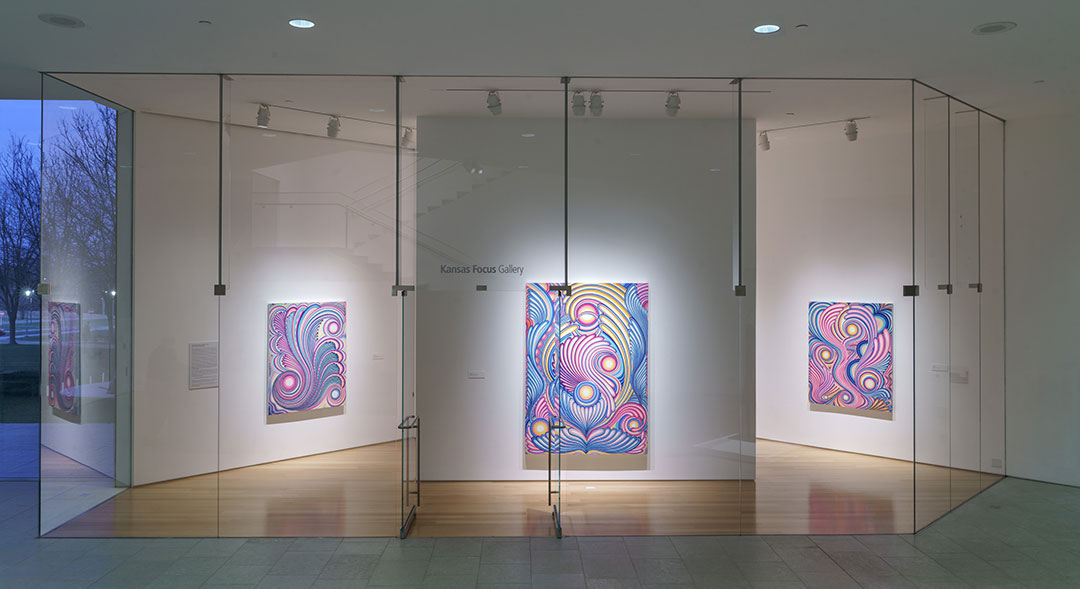
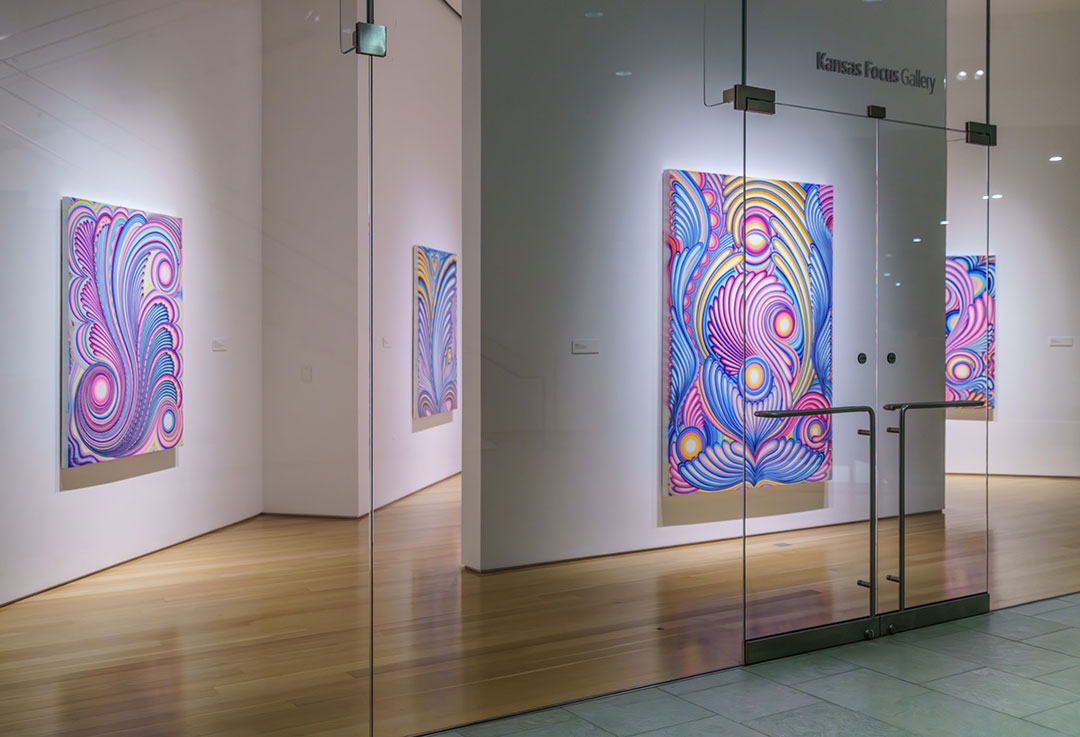
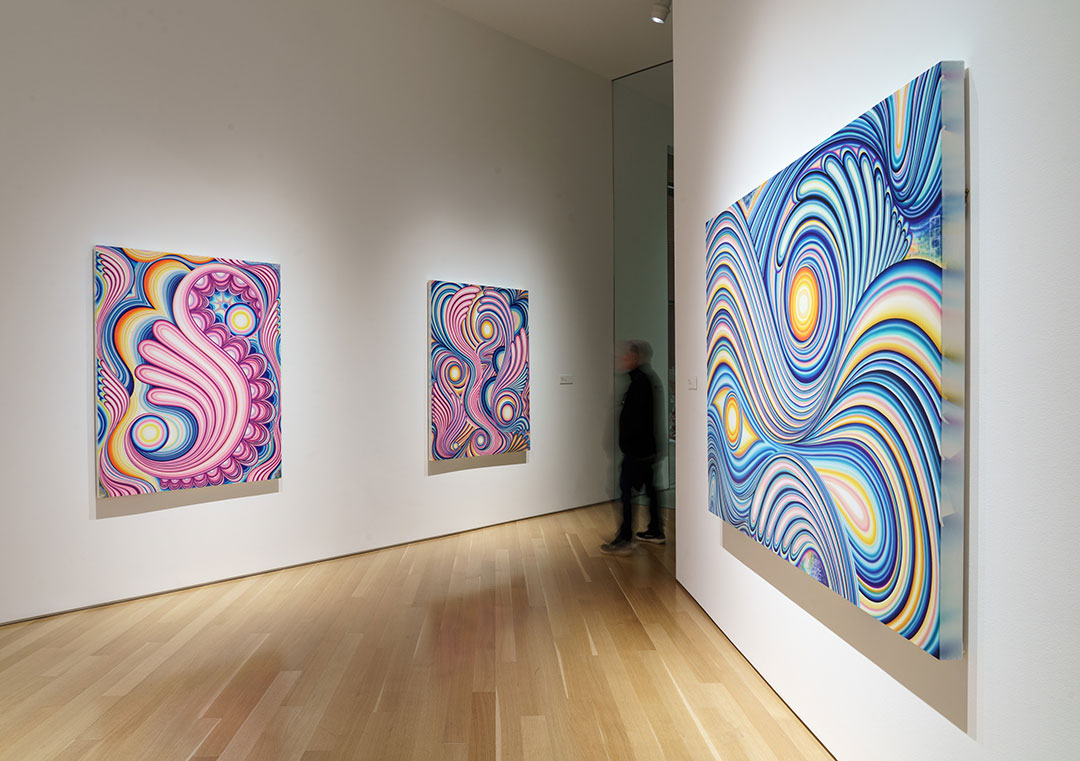
Angeline Rivas: I Had a Dark Night of the Soul and All I Got Was This Lousy T-Shirt
On view Dec. 13, 2025 through May 3, 2026
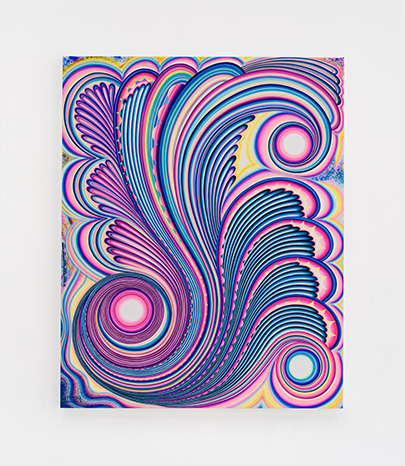
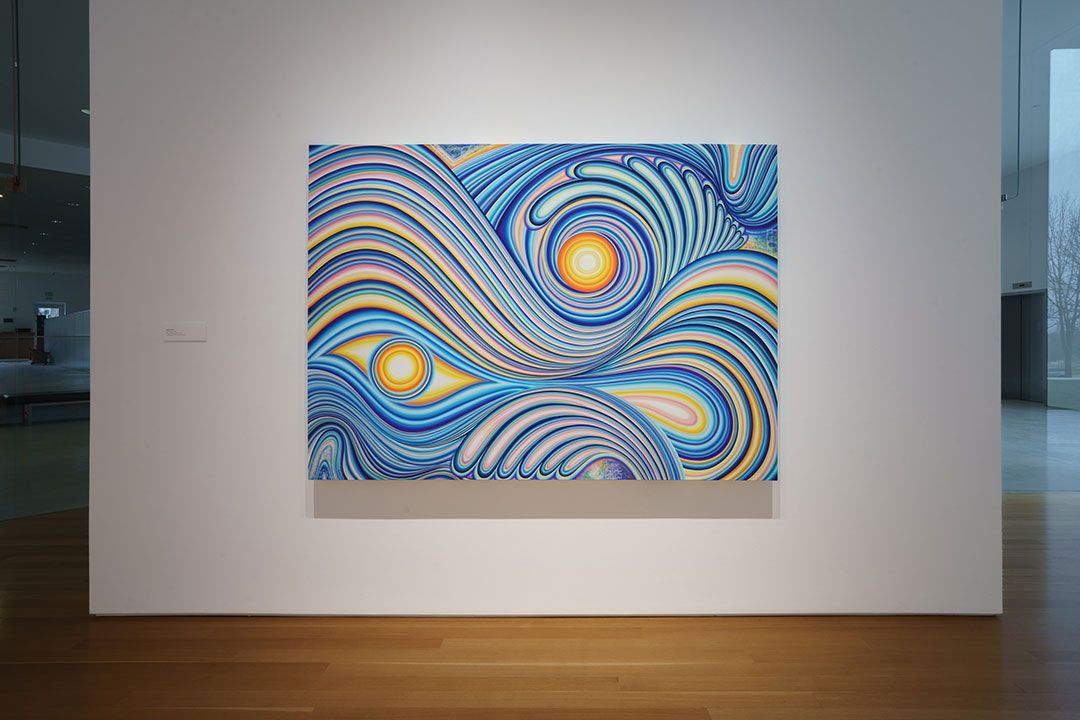
Angeline Rivas, Charm and Strange, 2024, acrylic, gouache, and graphite on panel, 60 x 48 in. Collection Nerman Museum of Contemporary Art, Johnson County Community College, Overland Park, KS, Acquired with funds provided by the Barton P. and Mary D. Cohen Art Acquisition Endowment at the JCCC Foundation. Photo: Chris Sharp Gallery.
Angeline Rivas (b. 1981) was born and raised in Kansas City, MO and is now based in Los Angeles, CA.
Rivas earned her MFA in 2022 from the ArtCenter College of Design, Pasadena, CA and her BFA in 2005 from Otis College of Art and Design, Los Angeles, CA.
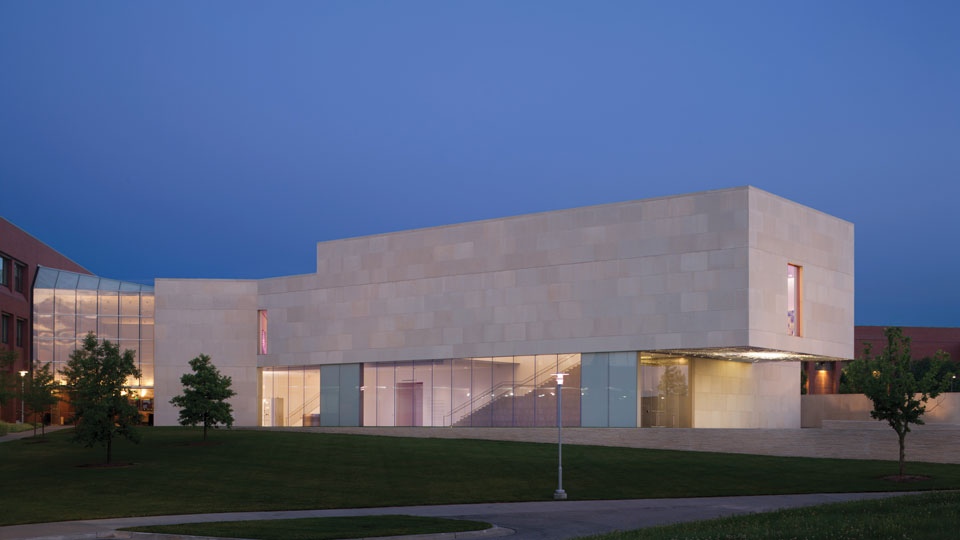
The Nerman Museum of Contemporary Art is proud to present Angeline Rivas’s first institutional solo exhibition.
On the Art of Angeline Rivas
by Christina Catherine Martinez — artist, writer, and comedian
I’ve never told anyone this, but when I was a kid, I wandered away from the family campsite on a Fourth of July trip, taking jerky little steps through the clumps of trees that sat between BBQ pits and tiled shower facilities, looking, I think, for something unfamiliar. I had already gotten up once in the middle of the night to go pee and screamed to no one at all when a bright green little frog plopped in front of my feet as I sat on the toilet. I was not born near anyplace that might be referred to as nature. We had gone out, packed the car top full of conveniences in an effort to get away from the city and see the stars for once, but all it took was a flick of the fluorescent bathroom lights to burn off the impression of the night sky, like changing channels on the boxy little TVs that glowed like orbs from within the nylon tents of our neighbors. I might have been what the cousins called a Little Baby, but I knew I was being sold something that wasn’t quite being delivered, an idea of purity and where it might be found but also there’s hot dogs and Tang if the landscape proves too much. There’s hot water and a hand dryer and a little frog who looks at you like you are the f**king problem. So, I followed the dark like a reverse beacon, feeling it thicken by the minute and me with it until I smashed tiny-face first into a chain link fence—the definitive limit of what I was being asked to consider—The Great Outdoors. On the other side of the fence was a flock of snowy egrets delicately picking their way around a large tidepool. There was a boom. The sky lit up with giant orbs of pink and orange and blue sparks in celebration of our nation’s independence. All at once the birds jerked up as a unit and began to swirl in the air, silhouetted against the fireworks like fleeing commas. The fireworks mirrored themselves in the tidepool, melding water and sky into a nebula of color and light that would’ve made a social realist run for the hills… I decided then I didn’t care what was promised, this was the most beautiful thing I would ever see in my life, and I weep at times, carrying the residue of such a lonely aesthetic experience that is always, in some way, seeking its counterpart.
I never told anyone this either, but the first time I saw an Angeline Rivas painting, I cried.
The miracle bombs of her canvases contain so many elements of this memory for me, I wonder if part of her wasn’t astrally projected somewhere into the pink fire, the lime-colored frog, the acid-orange Tang, served hot to the children in the morning in lieu of chocolate. If Rivas and I have shared affinities—for neon color palettes, Lisa Frank, cholo writing, Star Trek in all its forms, the internet as a pixelated hothouse of girlhood—these are not wholly circumscribed by assorted feelings of fate and other woo-woo adjectives endemic to our helpless Californian-ness, but to the particular media straddle of our generation. A childhood of landlines and analog television giving way to an adulthood deconstructing The Rabbit Hole Iceberg while downloading apps to remind us to go outside. When philosopher Donna Haraway wrote her Cyborg Manifesto in 1985, the term was leveraged as a metaphor to describe our relationships to technology as potentials for liberation. Now she owes us an apology tour. Baudrillard’s famous question “What are you doing after the orgy?” is a metaphor for what might happen in the wake of intense excess, or a moment of liberation… Now we’re… what, gooning?
People have been known to clutch pearls at many things in art: nudity, minimalism, sacrilege. The first is a question of moral symbolism, the second is a derogatory itch—a feeling that the artist hasn’t done enough—and the third is the umbrella term for the other two. The paintings of Angeline Rivas have none of these qualities, not in any imagistic way, anyway. The audible gasps that sometimes meet her pictures have more to do with the feeling that the artist has done too much; they’re mourning cries for the Final Boss of piety in painting, and that is taste. (Final Boss is a hyperbolic meme term, using the video game concept of a terminal enemy, the ultimate test, to describe a challenging corollary in real life). “Real life” itself might be a hyperbolic term, trying to capture the free-floating consciousness of the networked individual like swinging a butterfly net through smoke.
There is a lineage, for sure. The transcendentalist imagery of Agnes Pelton, the obscure Spiritualist content of Hilma af Klint, the sleek sensualism of Finish Fetish, can all be read into her pictures. But the form and process of Rivas’s hyperspectral, hyperdetailed paintings involves a fierce and heretical embrace of the uncanny valley between beauty and hideousness, and an idiosyncratic unity of influences both internal and external, both personal and aesthetic, that never stoops to anything so one-dimensional as self-expression. God, we both love stickers, though.
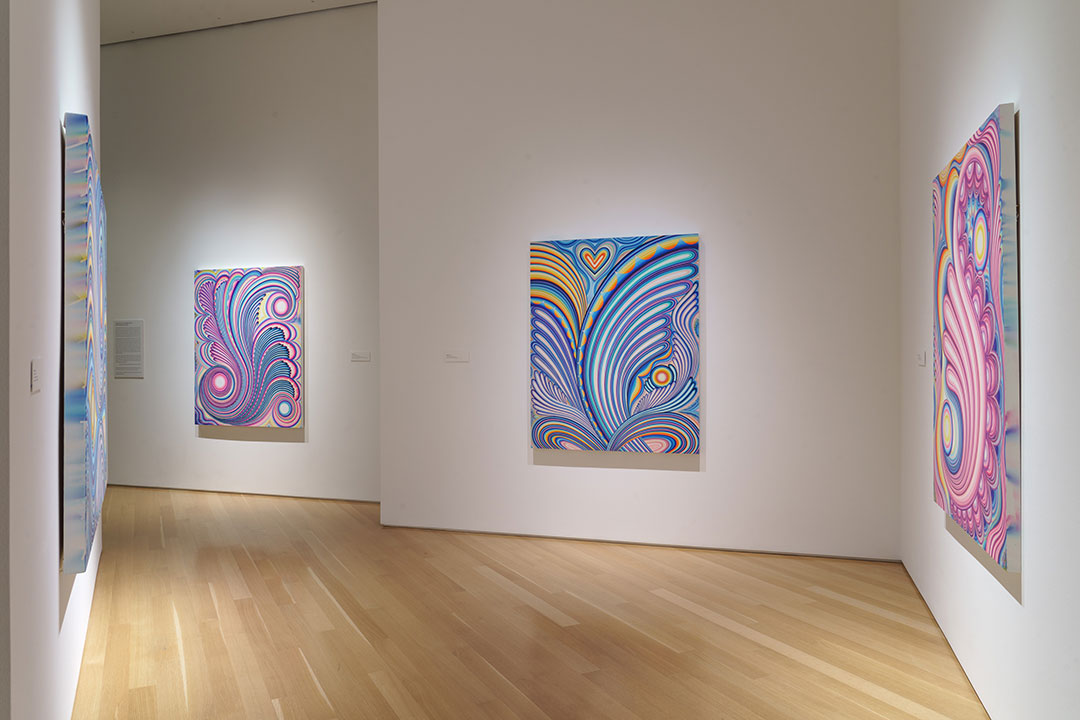
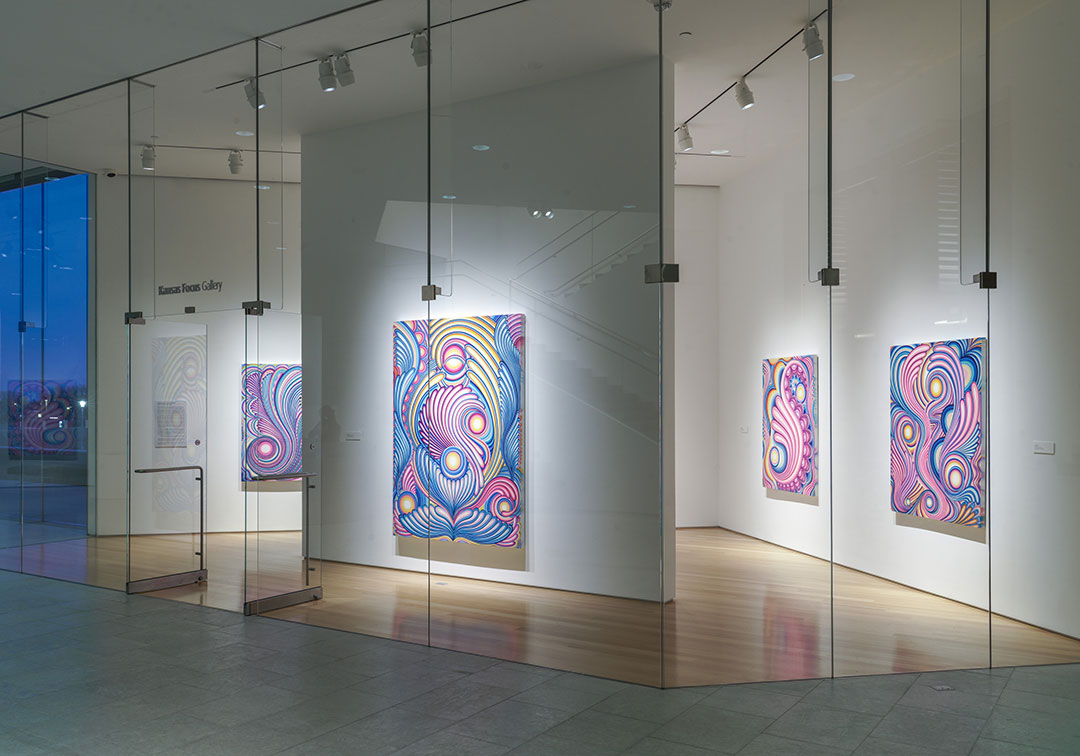
Her compositions begin as soft graphite sketches, sometimes filled in or made entirely with cosmetic make-up, the kind you’re supposed to put on your face before putting on a face for the outside world, or the front-facing camera. Before transmogrifying through the retinal cone-melting colors of her airbrush, her pictures are briefly genteel. Getting them on the canvas is a monastic process of taping off one florid section at a time, giving her shapes their hard edges and soft centers. If you go to Venice Beach, CA and the bacteria levels are too elevated for swimming, you might seek out the guys making street paintings of galaxies using quick airbrush tricks and flicks of paint on toothbrushes to mimic celestial bodies like planets and domes and stars. Rivas leverages the medium with such formal rigor and hysterical detail that her soft studies bloom to interdimensional dimensions, a marriage of spatial depth and an oddly pleasing flatness.
Painting is inescapably an experience of time, and Angeline’s paintings physically pulse with it, like a bouquet of multiverses. Zoom in though, and there are signs of life. Tiny chips in the surface of the paint are left to assert their individuality, little clusters of dripped paint splash through the margins, and odd doodles are penciled in all over like the scratching of a bored middle-schooler into their desk while sitting through a tired lecture on American history.
There’s a word I’ve been avoiding, hunkered down goblin-style in the uncanny valley between beauty and hideousness. It’s prettiness. It carries the same freight of dismissive piety David Batchelor describes in his 2000 book Chromophobia when people use the word colorful: “to be called colorful is to be flattered and insulted at the same time.” That these pictures might be pretty on top of everything else is the chief cause of their offense, but also the engine of their permission, which is the overriding sensation I get from them, and get still from this wild and tasteless country I call home.
“This painting,” Swiss writer Robert Walser once said of an unrelated picture, “portrays something like a moral dilapidation…”
“But are not loosenings of moral strictures at times, elegant?”
FREE ADMISSION
Tue., Fri., Sat.: 10 a.m.-5 p.m.
Wed., Thu.: 10 a.m.-8 p.m.
Sun.: noon-5 p.m.
Mon. and JCCC Holidays: Closed
Upcoming JCCC Holidays:
Independence Day: July 3-6, 2026
CAFÉ HOURS
Café Tempo is closed for the summer and will reopen on Tuesday, August 25, 2026.
Join the Nerman Museum mailing list
Download our free digital guide
