Norman Akers Navigates the Space Between
On view June 12 through December 6, 2026
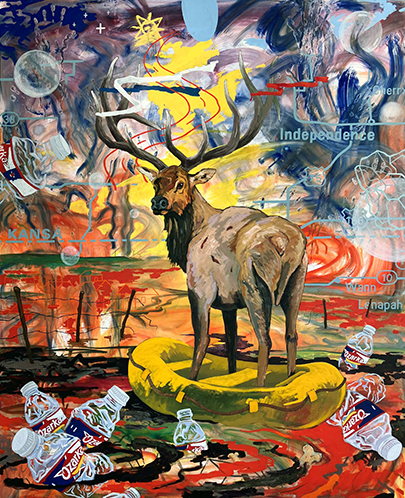
Norman Akers, Where Are We Going, 2026, oil on canvas, 75 x 60 1/4 x 2 in. Courtesy the Artist
Norman Akers has been mapping the world. His large canvases are filled with an interlayered web of cartographic iconography drawn from road maps, Osage philosophy, and his own visual vernacular. Through these maps, his images have become records documenting an introspective journey, navigating spaces between home and away, tracing the temporal shifts of place, and witnessing the ecological politics of who has a right to be and to belong. Until now, Akers’s paintings have been a diary. They are now a herald. His new work is a commentary on the unprecedented, rapid ecological degradation we are all experiencing, a call to arms for us all in this latter stage of the Anthropocene.
The abstractions of place are woven from the constructed map elements, often conflating Osage homelands in the before and since Removal. The elk and the turtle are cultural references to the earth and Turtle Island (North America), respectively. Together they manifest what Akers describes as “an abstraction of the relationship that humans have to the earth’s surface.” His bold, painterly brushstrokes visualize the speed and aggression with which the decline is happening. There is no time in this space to find an acute focus. Akers calls to us to look. We must look at the land, the disruption of the earth, the exploitation of water, and our own individual roles in this brutalization of our precious earth.
Each canvas has a bisecting horizon line, drawing from cultural notions of balance between earth and sky. Akers uses the horizon line to express an appreciation, an affection, for the earth’s perfection to provide for our very lives. It is within this place, this space that we share, that the metaphoric elk witnesses the rapidly changing destabilization of all that makes our survival possible.
The elk, ever present within Akers’s canvases, stands as an Osage visual mnemonic for the earth, perceived in the humps of its back as the hills of the prairie and the intersecting movement of its antlers that mimic the flow of riverine systems. In these canvases, the elk stands as witness to our desecration of the earth’s surface. He holds court, watching us capitalize the very resources upon which we rely, making them unaffordable for those who need them now and exhausting them for future generations. The elk returns the viewer’s gaze, steadfastly holding us each accountable for our personal actions.
There is no time to look at where the damage started nor to wait for the apocalypse. Akers asks us to look at the space between, — where we are now — and to consider to what end our individual choices will benefit and harm as we move forward. Each of us is caught in the same web of being, between the past and the future, held accountable by the elk’s unrelenting gaze.
There is no absolute end to this journey, only the recognition that we are on the journey together, sharing the only life raft with the earth itself. Our survival can be mutual but is not guaranteed.
—heather ahtone, Director, Curatorial Affairs, First Americans Museum, Oklahoma City, OK
This project is part of the initiative Home Is Where We Are: Art of First Americans. Spanning institutions across the Great Plains, it marks a coordinated focus on contemporary Indigenous art. Each organization presents a distinct project contributing to a collective that amplifies Indigenous perspectives. Participating institutions include the Chapman Center for Rural Studies; Kansas Studies Institute; Marianna Kistler Beach Museum of Art; Mid-America All-Indian Museum; Nerman Museum of Contemporary Art; Salina Art Center; Ulrich Museum of Art; and Volland, A Place for Art and Community — positioning the region as a destination for experiencing the art of First Americans.
FREE ADMISSION
Tue., Fri., Sat.: 10 a.m.-5 p.m.
Wed., Thu.: 10 a.m.-8 p.m.
Sun.: noon-5 p.m.
Mon. and JCCC Holidays: Closed
Upcoming JCCC Holidays:
Juneteenth: June 19, 2026
Independence Day: July 3-6, 2026
CAFÉ HOURS
Café Tempo is closed for the summer and will reopen on Tuesday, August 25, 2026.
Join the Nerman Museum mailing list
Download our free digital guide
